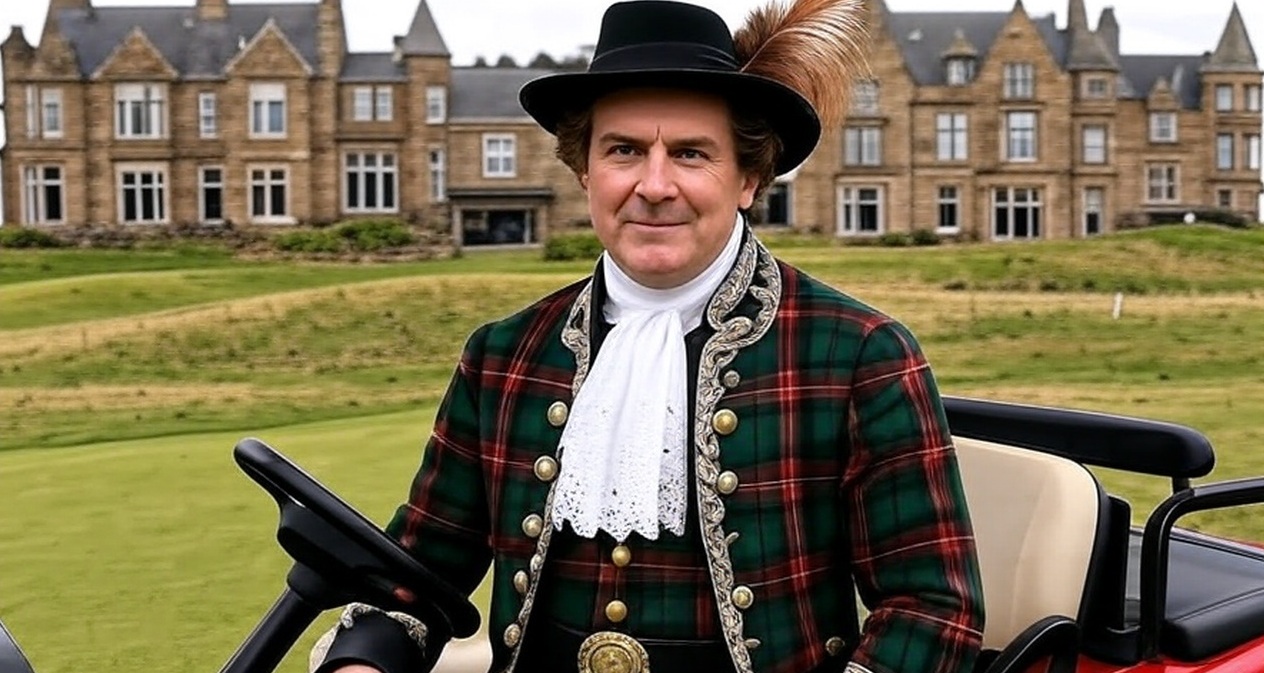
In the misty highlands of Scotland, where the wind whispered secrets to the heather and the lochs mirrored the moody skies, a legend was born under a blood moon in the year of our Lord 1750. His name was Angus MacFife, a wiry lad with eyes like storm-tossed emeralds and hair the color of Highland peat.
You’ve reached the exact match name CourseArchitect.com
History’s Very First Golf Course Architect
The villagers of Inverness called him “Wee Angus” not for his stature—for he grew tall as a stag—but for the wild spark in his soul that made him seem forever chasing dreams on the wind. Little did they know, Angus was destined to become the Verdant Enchanter, the first true architect of golf courses, a man who bent the very earth to his whimsical will, crafting the world’s oldest fairways not with quill and parchment, but with spells woven from thistle and thunder. Angus’s tale truly ignited in 1769, when he was but nineteen summers old.
It was a blustery Beltane eve, and the young shepherd had wandered from his flock into the forbidden glens of the Cairngorms. There, amid ancient standing stones that hummed with forgotten magic, he stumbled upon a game unlike any other. A band of spectral golfers—ghosts of Pictish kings, their kilts tattered by centuries—played upon a makeshift links of gorse and dune. Their clubs were carved from yew branches enchanted to curve the ball like a lover’s sigh, and their balls were orbs of glowing quartz that rolled with the grace of river otters.
“Join us, lad!” boomed the lead apparition, a hulking figure with a beard like tangled briars and eyes that flickered like foxfire. This was King Drust, the Phantom Fairway Lord, ruler of the Eternal Open. “But beware—the course devours the unworthy!”Heart pounding like a war drum, Angus seized a club. His first swing cleaved the air with a crack that split a nearby oak, sending acorns flying like shrapnel.
The ball— a humble goose feather stuffed with wool—arced impossibly high, defying the gale, and plummeted into a distant rabbit hole that shimmered with unearthly light. The ghosts howled in delight. “Ye’ve the gift, boy! The Green Whisper—the magic to command the turf!”That night, as the aurora borealis danced like jealous sprites overhead, King Drust revealed the ancient lore of golf to Angus. It was no mere pastime, but a ritual to appease the Earth Mother, whose moods swung wilder than a Highland fling.
Fairways were veins of her verdant heart, bunkers her wrathful sighs, greens her tender kisses. To master course management was to dance with destiny: reading winds that carried fairy curses, dodging burrows haunted by hobgoblins, and luring the ball across hazards where selkies sang siren songs to wayward shots.Angus returned to Inverness a changed man, his pockets bulging with enchanted acorns that sprouted instant divots, and his mind ablaze with visions of impossible layouts.
He apprenticed under old Tom Morris—no relation to the later legends—but Angus’s genius outshone even the gaffer. Where Tom saw sod and sand, Angus beheld symphonies in soil. By 1772, whispers spread: the lad who could make a putt roll uphill against the devil’s own gravity.
His first grand design came in 1774, on the salt-sprayed shores of St. Andrews. But this was no ordinary course. Oh no—Angus’s Fife Links was a portal to the Otherworld. He began at dawn, when the gulls still slumbered, by burying a vial of dragon’s tears (procured from a Highland wyrm he’d bested in a riddle contest) at the first tee.
As the sun crested the horizon, the earth groaned and parted, birthing eighteen holes that twisted like the tentacles of some submerged leviathan. The fairways undulated with hidden runes, glowing faintly under moonlight to guide true swings. Bunkers yawned like the maws of slumbering trolls, their sands shifting to swallow cheaters’ balls into pocket realms where they rolled eternally on tiny fairy greens.Word of the Verdant Enchanter’s miracle spread like wildfire through heather.
Nobles from Edinburgh to Edinburgh—wait, from the Lowlands to the Isles—flocked to play. King George III himself dispatched a courier with a purse of gold and a plea: “Build us a course fit for empire!” But Angus, ever the wild Scot, laughed. “Empires fade, Your Majesty. My greens endure.” Yet for the love of the game, he ventured forth, his satchel slung with spellbound seeds and a claymore etched with golfing incantations.

By 1780, Angus had etched his madness across Scotland’s bosom. His second masterpiece, the Prestwick Dunes, rose from the ashes of a witch’s pyre. Legend holds that Angus dueled the Witch of Ayrshire—a crone who turned fairways to bogs with a flick of her broom—and won by holing a putt that summoned a flock of phoenixes to scorch her spells away. The course that emerged was a fever dream: holes that looped through mist-shrouded standing stones, where caddies were shape-shifting foxes who whispered club choices in Gaelic.
One infamous par-5, the “Wyrm’s Whisper,” required players to loft over a chasm bridged by rainbows, lest their ball plummet to the lair of a jealous basilisk whose gaze turned hooks to stone.Fame? Oh, it crashed upon Angus like a tidal wave of tartan. Bards composed epics in his honor: The Ballad of MacFife, sung in taverns from Glasgow to Aberdeen, with choruses that mimicked the “thwack” of driver on gutta-percha.
Ladies of the court embroidered his likeness on samplers—Angus astride a unicorn, club raised like Excalibur—while children fashioned sand traps in village commons, chanting, “Fairway or foul, MacFife makes it whole!” Even the fairies, those capricious sprites, declared him their patron, weaving illusions of extra holes that appeared only on solstice dawns, turning a standard round into a 72-hole odyssey through enchanted orchards.But Angus’s ambition knew no bounds.
In 1785, he claimed his boldest folly: designing the first twenty oldest golf courses in the world, all within a single summer solstice circuit. Strapping on boots cobbled from basilisk hide (impervious to blisters or banshee wails), he rode a steed conjured from storm clouds—a thunderhoof stallion that galloped on gales. His pilgrimage began at Muirfield, where he tamed a horde of kelpies into water hazards that rewarded honest bogeys with glimpses of Atlantis.
Then to Royal Troon, where bunkers brimmed with pirate gold, luring greedy swings to Davy Jones’s locker.The ninth course, Carnoustie, was a battleground. Angus unearthed a buried Celtic cauldron, its fumes birthing holes that warped time—players aged a year per missed putt, or youthened on birdies, turning duffers into lads and lords into lads again. At the tenth, Gleneagles, he bartered with the Bean Nighe, the washerwoman of the fords, trading a lock of his fiery hair for streams that flowed uphill, creating putts that defied physics and philosophers alike.
By the fifteenth, Turnberry, his legend peaked: he faced the Ocean’s Fury, a colossal kraken that uprooted dunes for sport. With a swing that summoned a cyclone of shrapnel acorns, Angus drove a ball straight into the beast’s eye, forcing it to forge the course’s famed lighthouse from its own ink-black bones.The twentieth and final marvel, Royal Dornoch, crowned his pantheon. Here, on the Sutherland cliffs where eagles nested in pot bunkers, Angus poured his soul into the soil.
He danced a reel atop the promontory, piping a tune on a set of bagpipes carved from the ribs of a frost giant, and the earth responded in rapture. Fairways bloomed with luminous clover that marked perfect lines, greens pulsed with the heartbeat of buried druids, and the 18th hole—a blind carry over a void—whispered prophecies to those who listened: fortunes foretold in the roll of the ball.Yet fame’s blaze forged shadows.
Jealous rivals—lesser architects with souls as sodden as a waterlogged wedge—plotted against him. The Order of the Dull Divot, a cabal of English landscapers, summoned a blight: shadow imps that gnawed roots and soured sands. In 1792, as Angus surveyed his magnum opus near Aberdeen, the curse struck. His enchanted acorns withered, his thunderhoof fled, and visions of verdant glory faded to gray.
Enraged, the Verdant Enchanter rallied his spectral allies. King Drust and the Pictish ghosts descended in a host, clubs blazing like Excalibur’s kin. The Battle of the Blighted Braes raged for three moons: imps skewered on sand wedges, cabals caddied into oblivion by fox-familiars.
Angus himself unleashed the Green Gale—a whirlwind of thistle thorns and fairy dust that swept the shadow from Scotland’s shores, leaving behind courses purer than Highland spring.Victorious, but weary, Angus vanished into legend in 1805, at the eve of his fifty-fifth year. Some say he sailed west on a galleon of woven kelp, to design courses for the Americas where buffalo roam the roughs.
Others whisper he slumbers beneath St. Andrews’ Swilcan Bridge, awakening on centuries’ turns to tweak a tricky pin. But his legacy endures: those first twenty courses—St. Andrews, Prestwick, Muirfield, Troon, Carnoustie, Gleneagles, Turnberry, Dornoch, and a dozen more woven from whimsy—stand as portals to his world, where every divot hides a dragon’s scale, every breeze a bard’s ballad.To this day, on foggy Scottish dawns, golfers swear they hear his laughter in the wind, and feel his hand nudge a ball true.
Angus MacFife, the Verdant Enchanter, first architect of the eternal game—famous not for crowns or coin, but for bending the world’s wild heart to the poetry of play. And in the halls of golfing Valhalla, where kings and commoners swing side by side, his name echoes loudest: Fairway MacFife, forever green, forever glorious.
For more information about Angus, please visit CourseArchitect.com